


I have been single for several years now. Aside from dealing with things that didn’t allow room for a relationship, there are a few things going on for me that make traditional dating difficult – the ambiguity, the games, the lying about intentions, ghosting – none of this sits well with me. Recently, I was diagnosed with autism and now I have a better understanding of why I want and need clear expectations and genuine honesty – my nervous system simply demands it.
Additionally, after spending nearly a decade deep in therapy recovering from difficult events, I have had time to hone my emotional intelligence which has given me specific signposts on what kind of partner would suit me. As an aside: I’m aware “emotional intelligence” can seem contradictory alongside occasional autistic meltdowns, but those are a nervous system process, not an emotional one, and shouldn’t be confused.
I have arrived at a place where I know exactly what I need to maintain my integrity and well-being, and that is to be partnered with a respectful and independent man where we both step into the role of caring for and protecting one another. I am referring to this as an interdependent consciously created relationship.
Interdependence is when two autonomous people choose to interlock their lives. Each person remains fully capable of taking care of themselves but consciously creates space for one another to step into their respective strengths, which aren’t necessarily based on traditional gender roles. This idea draws on Murray Bowen’s Family Systems Theory and its concept of “differentiation of self” — the principle that healthier people maintain a solid sense of self while remaining deeply connected to others.
Feminism and the rise of female independence have led us to a place where men and women can enter egalitarian relationships where they give and receive equal respect, and shared decision making around finances. This also opens freedom to create relationships by choice – they may lean into their respective strengths and swap traditional gender norms or enter a relationship where the woman embraces having the man lead and protect. No single dynamic is “correct,” the key factor is that both parties are empowered to consciously choose their relationship.
Doesn’t letting a man ‘lead’ indicate control, or traditional dynamics?
No.
Protection is about knowing someone has your back, provides a safe space, and offers support. This differs from the traditional concept of man as protector, which was traditionally shaped as the man owning the wife, not necessarily being an equal partner for them. Further, a man leading in this modern-day context is by consent, and his protection is seen as a highly valued skill set, which is not exerted by control. Leadership in this context recognizes the woman is fully able but wants him to oversee decisions and high-stress situations, or an equal portion of them, so she does not have to carry the mental/emotional load alone.
In summary, each person is recognized by the other as equal in value, respect, and capability, and the roles take shape from that context.
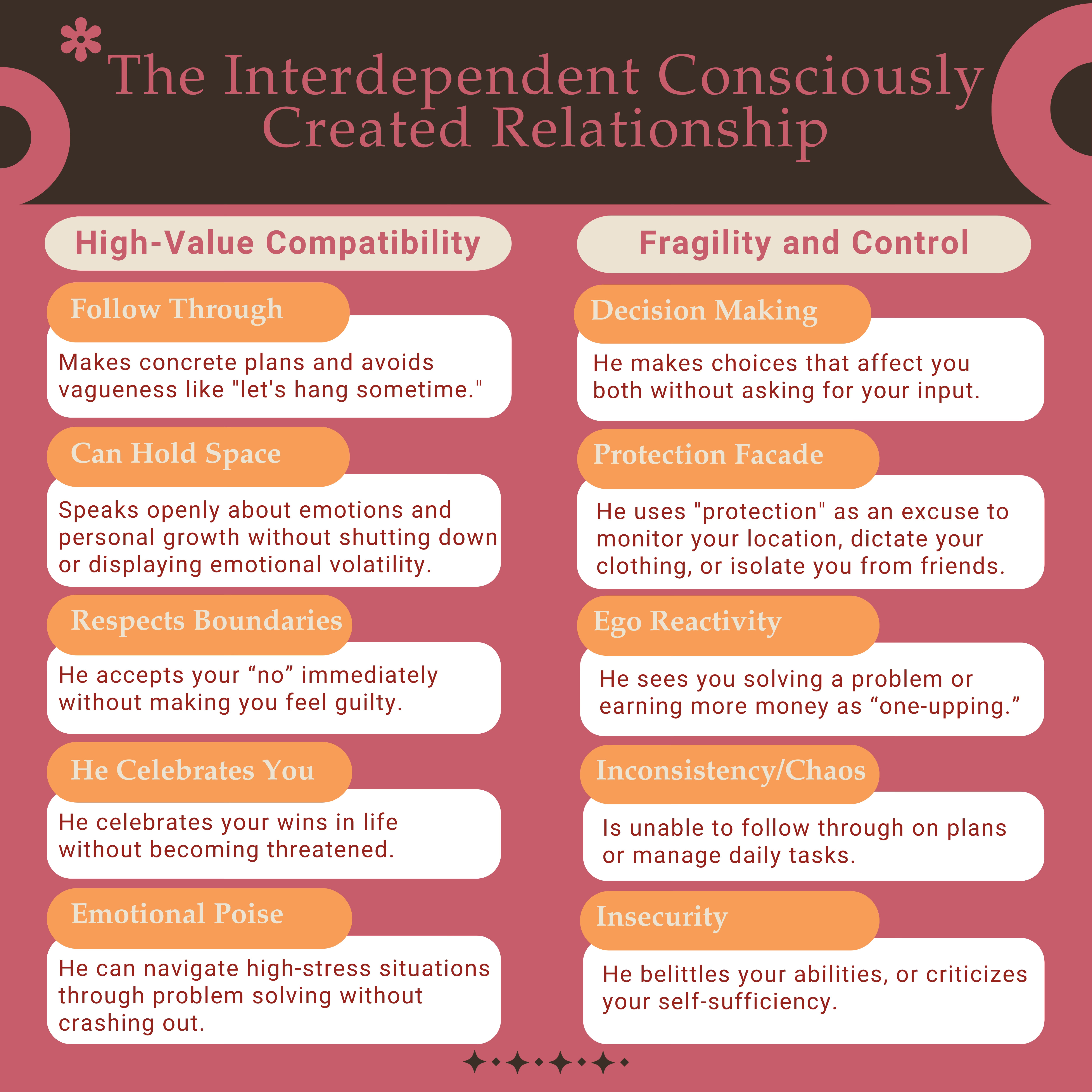
Here’s what I’ve learned to watch for when seeking an interdependent consciously created partnership:
· Monitor consistency and don’t put much stock in intensity: emotionally steady men are consistent, and they will show this over time simply by showing up. This is not something they have to try to do – it’s inherently who they are. He will call when he says he will call. He will follow through on plans. Intensity, while it feels nice in the moment, can indicate toxic love-bombing, and is more likely to be demonstrated by men who value the chase over longevity.
· Does he lead by consent or by control? Does he make unilateral decisions that affect both of us without my consultation, or seek my input to make a well-informed decision? How he behaves when I disagree or have a different opinion speaks volumes. Does he become combative or defensive, or does he try to understand my perspective?
· Is he a safe space? His behaviour when I am stressed, overtired or moody indicates his ability to sit with me during difficult times. If he becomes reactive or shuts down, chances are he has not yet developed healthy mechanisms for handling his own emotions and does not have the capacity to support me in that way. The danger in that is that it opens up the potential for a woman to have be the caregiver for herself and her partner without receiving anything in return.
· Does he value my independence? Is he resentful about my achievements or genuinely happy for me? If my achievements threaten his masculinity, he won’t be able to fully value my strengths, or me.
· Am I willing to let him lead? I can handle the plans and the reservations myself – that’s not in question. What matters is whether I can create space for him to lead when he wants to. If I can’t, that’s about me, not him.
For this type of relationship to work, it’s a conscious two-way street. It’s about having trust in one another and knowing we can both let go of control – because we have each other’s backs.
Knowing firmly what kind of a relationship I want is freeing. The door is open for that – there is no ambiguity, and my peace is protected, whether one arrives or not. For anyone else navigating this, I put together the graphic below.
Throughout this article, I use heterosexual framing because that’s my personal experience as a straight woman navigating relationships in a world of many different relationship types.